

Business Statistics is the application of statistical methods and techniques to business problems and decision-making. It enables managers, researchers, and business professionals to analyze data, identify trends, forecast outcomes, and make informed decisions.
Course Learning Outcomes
By the end of this course, learners should be able to:
· Explain the role of statistics in business.
· Collect and organize business data.
· Apply descriptive statistical techniques.
· Use probability in business decision-making.
· Apply sampling techniques.
· Conduct hypothesis testing.
· Analyze relationships using correlation and regression.
· Forecast future business trends.
· Interpret statistical results for business decisions.
- Teacher: Admin User
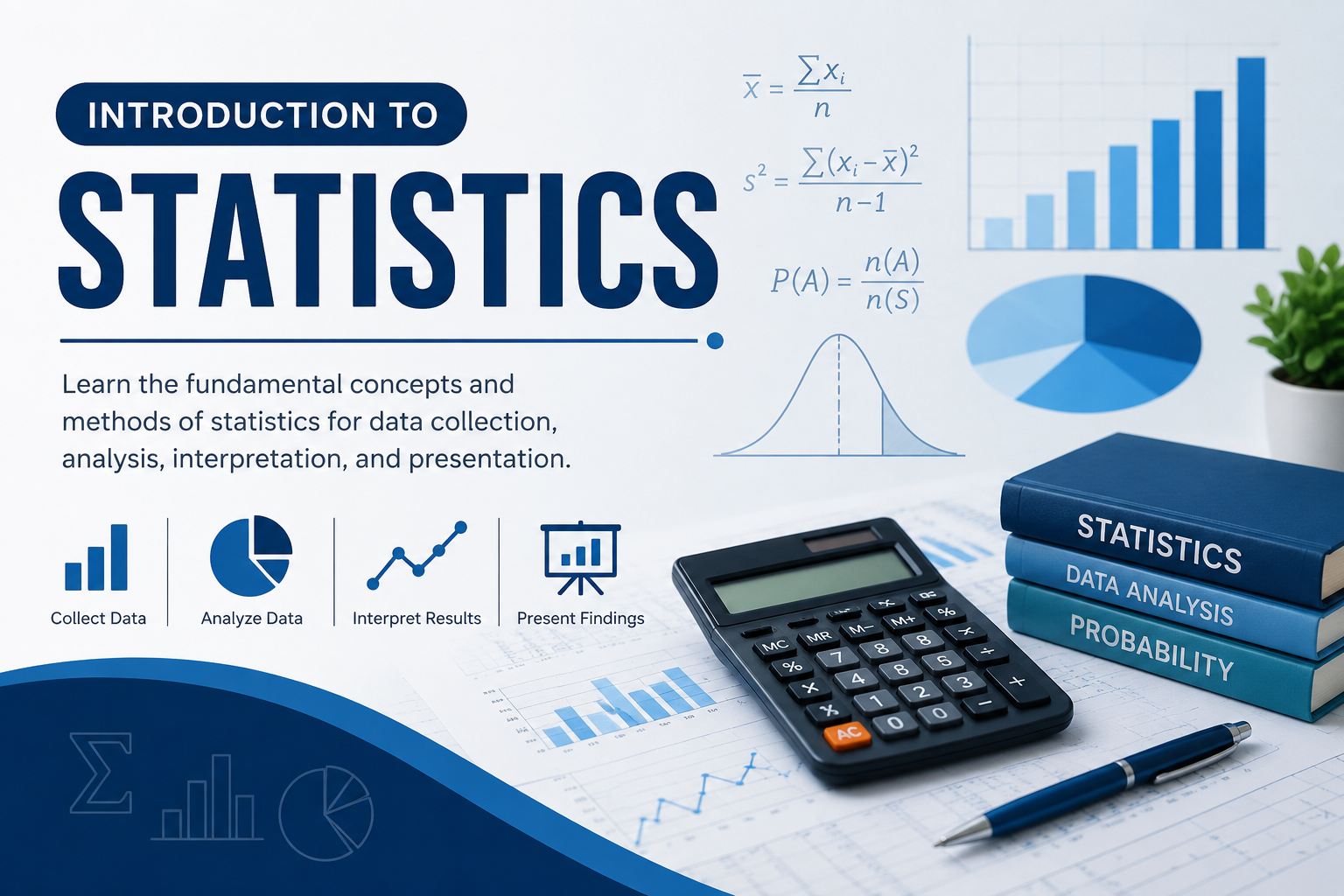
This course introduces learners to the basic concepts and methods used in statistics for data collection, analysis, interpretation, and presentation.
Learning Outcomes
By the end of this course, learners should be able to:
- Define statistics and its importance.
- Identify different types of data and variables.
- Apply data collection methods.
- Calculate measures of central tendency.
- Calculate measures of dispersion.
- Present data using tables and graphs.
- Apply basic probability concepts.
- Teacher: Admin User
Biostatistics
Precision analytics for the frontline of medicine.
-
Learning Outcomes:
-
Design statistically sound clinical trials that meet international regulatory standards.
-
Analyze longitudinal data to track disease progression over time.
-
Interpret survival rates and hazard ratios for medical research publications.
-
-
Theoretical Core Topics:
-
Epidemiological Metrics: Sensitivity, specificity, and Positive Predictive Value (PPV).
-
Survival Analysis Theories: The logic behind the Cox Proportional Hazards Model.
-
Experimental Design: Blocking, randomization, and controlling for confounding variables.
-
-
Interactive Activities:
-
Outbreak Simulation: A gamified module where students must use "patient zero" data to calculate the $R_0$ (reproduction number) of a simulated virus.
-
The Ethics Audit: A peer-review workshop where students critique a historical (real) medical study to find statistical biases or ethical flaws.
-
- Teacher: Admin User